Surgery facilities are available for users planning to perform experiments with instruments that are part of the NORBRAIN facility (tetode recordings, Neuropixels recordings, 2P microscope imaging, etc).
Our surgery facilities are equipped with setup for anesthesia and surgery for intracranial delivery of substances or implantation of devices, in mice or rats. Necessary equipment for supportive therapy and postoperative care are also available, along with consumable materials and storage possibilities for medicines and test substances.
Storage of medicines and test substances
Ventilated cabinets are available for storage at room temperature, and fridges and freezers are available for products that need to be stored at cold temperatures.
Instrument sterilization
Surgical instruments must be sterilized before they can be used in surgeries. We have equipment for both dry heat sterilization and steam autoclaving.
Specifications:
Dry heat sterilization is done using a Termaks drying oven with adjustable temperatures and a display to control the temperature.
For steam autoclaving we have a Tomy high-pressure steam sterilizer.
Alternatively, glass bead sterilizers may be used to re-sterilize instruments.
Anesthesia
Animals must be anesthetized during surgeries. We have setup for gas anesthesia, which is easy to adjust to achieve suitable depth and a balanced anesthesia.
Specifications:
All surgery tables are set up with a vaporizer for either isoflurane or sevoflurane, with the possibility to use medical air and oxygen as the carrier gas. Medical air is delivered from a central system in the building. Oxygen is delivered from oxygen concentrators located in the surgery rooms. The gas anesthesia can be delivered to an induction chamber for induction of anesthesia, to a coaxial mask for maintenance of anesthesia, or to the stereotaxic mask for maintenance during the surgical procedure. The adjustment of the delivery pathway can easily be done by the user. To limit the exposure of the user, the surgery tables are down-drafted and we have an adjustable hood above the table.
Stereotaxic setup
The stereotaxic setup is especially designed to do find the correct area of the brain, with the use of precision instruments and coordinates based on anatomical landmarks. This gives the possibility to reach the exact area you are interested in.
Specifications:
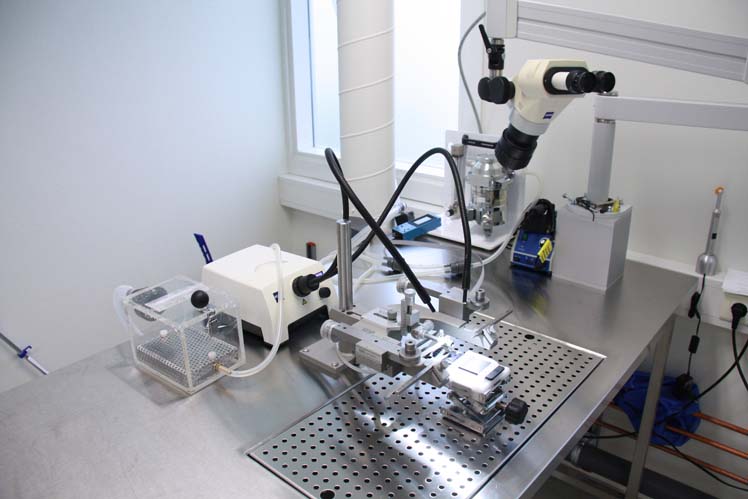
The surgery tables are equipped with stereotaxic frames from Kopf Instruments, either a model 1430-B “U” frame for rats, or a model 900 “U” frame for mice. We have two main types of manipulators that can be used with the frame:
- Model 1760 Micro Manipulator (10 micron resolution): X, Z adjustment – Metric Vernier scale 80 mm travel, calibrated dial – 10 micron increments, 1.0 mm of travel per revolution. Y adjustment – Manual adjustment 100 mm each side of zero (A/P bar) 0.1 mm Vernier scale.
- Model 1460 Electrode Manipulator (100 micron resolution): X, Z adjustment – 80 mm travel calibrated 0.1 vernier scale (100 micron increments), 3.0 mm advance per revolution. Y adjustment – Manual adjustment 100 mm each side of zero (A/P bar) 0.1 mm Vernier scale
The manipulators are used to locate the correct area, or as holders for drill, implants, syringes or pumps.
Drill
Specifications:
Micro motor handpiece drills from Foredom Electric are available on the surgery tables. The drills are small and flexible, they have speed control and can be adjusted to either manual control or foot-pad control. The drills can be integrated with the manipulators on the stereotaxic setup.
Systems for micro-injection
When the surgery is done to deliver a small volume of a substance to a localized area in the brain, it is necessary to use special equipment to do this with high precision.
Specifications:
Several systems for delivery of substances in the microliter or nanoliter scale are available.
- Hamilton syringes have ultrafine needles and can deliver substance in the nanoliter scale. From Hamilton Company
- Nanoliter 2010 micro-injection system, which can be combined with a Micro 4 microsyringe pump controller, from World Precision Instruments
- Nanoject III programmable nanoliter injector, from Drummond Scientific Company
Light source
It is important to have sufficient light when doing surgeries. On the surgery tables we have lamps with flexible tubes so that the user can direct the light to the area where the light is needed.
Specifications:
The light source is LED connected to fiberoptic tubes. The user can adjust the direction of the light, and also the light strength, through a dimmer.
Heat support
Providing heat support during the surgery is important to maintain the body temperature of the rodents.
Specifications:
The surgery tables are equipped with an electric heat pad that is located on top of the platform where the animal is placed during surgeries. The heat pad is connected to a temperature controller with a display to monitor.
Fluid support
To prevent dehydration, fluids are given to the animals. Fluids are heated to body temperature.
Specifications:
A water bath with adjustable temperatures facilitates the preparation of body-temperature fluids which are given as fluid therapy to the animals during surgeries.
Stereo microscope
In order to get a good overview of the surgical field, the microscope gives a nice opportunity to see the area and make necessary adjustments.
Specifications:
We have stereo microscopes from Nikon and Zeiss, with adjustable focus and zoom. Some of the microscopes are connected to a camera that transfers the view to a screen, so that observers can follow the surgery.
Ultrasound imaging
One room has a high-frequency ultrasound imaging system that gives high-resolution images in space and time, of small anatomical structures. This gives the possibility to do image-guided procedures, for example.
Specifications:
The ultrasound scanner is a Vevo 1100 from Visualsonics, with a MS550S transducer (20-40 mHz and 16 mm penetration), an integrated rail system for positioning the animal and an image-guided injection system. A physiology monitor helps to follow the vital body functions during the procedure. The setup is connected to gas anesthesia. Available functionalities on the ultrasound scanner are M mode, B mode, colour doppler, pulse wave doppler, needle guide, and storage and post-processing of images and videos.
Post-operative recovery chamber
The surgical facilities are equipped with recovery chambers where animals can wake up from surgeries. The recovery chambers give the animals a warm and calm environment for the first hours after surgery.
Specifications:
The recovery chamber is a Maxi-Thermacage from Datesand. The chamber allows for precise temperature adjustment and control through a display. The temperature is evenly distributed inside the chamber.
Other laboratory equipment
The surgical facilities are also equipped with general laboratory tools such as shakers (for example MS3 basic, IKA), micro-sentrifuges (Mini Star, VWR), an ice cube machine (Porkka), and a water purification system (Direct-Q, Merck Milipore).
Please note: Participating during animal experiments requires that the following conditions are met:
- People need to have completed the education and training in laboratory animal science as required by the national competent authority (The Norwegian Food Safety Authorities) equivalent to, at minimum, function (a) (persons who perform procedures on animals) according to the EU commission’s framework document for education and training. The local person responsible for animal care will need to evaluate the documents/certificates of the completed education and training.
- The experiments must be approved by the Food Safety Authorities, and the local animal welfare body must be oriented about the experiment in advance. The animal welfare body can set conditions for the experiment, based on local routines and guidelines
- People participating in the experiment must have been introduced to local routines regarding, for instance, health and safety, and use of the animal facility
- People must have been trained in the correct use of the equipment